
Electric Fence Certificate of Compliance in Cape Town, Western Cape
Book a registered Electric Fence System Installer to test your fence against SANS 10222-3, with warning signs and earth spikes supplied on site. Your electric fence CoC is valid for 2 years across the Cape Town metro.
Get a Free Electric Fence CoC Quote — Fast
Tell us what you need and we’ll send your price now.
Prefer to talk? Call 071 293 2423
✔ Registered, Compliant & Accepted
Every electric fence CoC we arrange is issued and signed off by an EFSI-registered Electric Fence System Installer in line with SANS 10222-3. The issuing professional’s registration number appears on your certificate, so it is fully verifiable and accepted by conveyancers, banks and the Deeds Office. We only work with correctly registered installers — a certificate from an unregistered person is not valid.
An electric fence CoC is the certificate a registered Electric Fence System Installer issues after testing your fence against SANS 10222-3, and it is required whenever a property with an electric fence changes hands. Warning signs and earth spikes are fitted on site. It stays valid for two years and costs R550 to R650.
COC Certificate issues Electric Fence System Certificates of Compliance across Cape Town, Western Cape. We have assisted property sellers, buyers, and estate agents in obtaining their electric fence EFSCC on time. With every inspection conducted by a registered Electric Fence System Installer (EFSI) licensed with the Department of Employment and Labour, we deliver fast, reliable compliance certification for all types of electric fence installations across the Cape Town metropolitan area.
- DoEL-licensed EFSI inspectors on every inspection — registration numbers verifiable on the national register
- Registered electric fence compliance inspections for Cape Town property transfers —
- Certificates issued within the validity window — we understand transfer deadline pressure
- Calibrated fence voltage meter and pulse energy tester on every inspection — SANS 10222-3 parameter verification
- SANS-compliant warning signs and galvanised earth spikes supplied and fitted on-site — no delays for minor non-compliances
- Vegetation clearance assessment and pruning recommendations included in inspection report
- Itemised fault report with fixed-price remediation quote within 2 hours of inspection
- R5 million public liability insurance on all inspection and remediation work
- Serving all Cape Town suburbs — electric fencing is standard in Northern Suburbs, Southern Suburbs, and Helderberg security estates
In short: an electric fence certificate of compliance — or electric fence compliance certificate — confirms your electric fence system meets SANS 10222-3 and the Electrical Machinery Regulations under the Occupational Health and Safety Act 85 of 1993. It may only be issued by a registered Electric Fence System Installer, and is required whenever a property with an electric fence is sold.
What Is an Electric Fence System Certificate of Compliance?
An Electric Fence System Certificate of Compliance (EFSCC) is a legal document confirming that an electric fence installation complies with SANS 10222-3: Electric fence systems for premises and the Electrical Machinery Regulations under the Occupational Health and Safety Act (Act 85 of 1993). It may only be issued by a registered Electric Fence System Installer (EFSI) licensed with the Department of Employment and Labour.
The regulation took effect on 1 October 2012. Any electric fence that was installed, re-installed, extended, repaired, or modified after that date must have a valid EFSCC. For property transfers, a valid EFSCC is required for any property that has electric fencing — regardless of when the fence was originally installed.
Electric fencing is standard in a very large proportion of Cape Town’s residential properties, particularly in security estates, gated communities, and suburbs in the Northern Suburbs, Southern Suburbs, and Helderberg. With the high prevalence of electric fencing in Cape Town, the EFSCC is now one of the most frequently required compliance certificates in the metro’s property market.
Operating an electric fence without a valid EFSCC exposes the property owner to significant personal liability under the OHS Act, and most short-term insurers will decline claims related to electric fence incidents where no valid EFSCC is in place.
Electric Fence Regulations in South Africa
Electric fencing is governed by the Occupational Health and Safety Act 85 of 1993, read with the Electrical Machinery Regulations of 2011. The technical standard the installation is measured against is SANS 10222-3, which sets out the requirements for non-lethal electric security fences — energizer output, warning-sign spacing, height and clearance, earthing, and separation from the mains supply.
Electric fence CoC requirements for you as the property owner
- Every electric fence system installed on or after 1 October 2012 requires a valid Electric Fence System Certificate of Compliance.
- For a system installed before that date, the certificate falls due at change of ownership of the land the system stands on.
- The certificate may be issued only by an installer registered with the Department of Employment and Labour as an Electric Fence System Installer.
- The system is measured against SANS 10222-3, and non-compliance is corrected before a certificate can be issued.
- The obligation sits with the owner or lessor of the property, not with the security company that fitted the fence.
The practical consequence at transfer is that an electric fence turns a routine sale into a conditional one. Conveyancers will not register without the certificate where the system falls inside the regulations, and an insurer assessing a claim involving the fence will ask for it too.
What the Electric Fence Inspection Covers
- SANS/IEC-listed energizer model verified
- Correct energizer output rating for total fence length
- Properly earthed energizer chassis (separate from electrical earth)
- Correct mains supply wiring, fusing, and isolator switch
- Indoor installation in weatherproof enclosure or approved housing
- Output voltage and pulse energy measured (≤10kV, ≤5J per SANS 10222-3)
- Minimum 3 earth spikes, each 1.2m long, 3m apart
- Additional spikes required: minimum 1 per 30m of fence perimeter
- Correct conductor cross-section for earth connection
- Fence earth system kept separate from building’s electrical earth
- Earth system continuity tested from energizer to furthest spike
- Minimum height: 1.5m above wall or 450mm freestanding above boundary
- No vegetation contact with live wires at any point
- Correct wire gauge and tension throughout
- All insulators intact — no cracking, burning, or tracking marks
- No sagging, broken, or improperly joined wire strands
- Physical barrier compliance (where fence is freestanding)
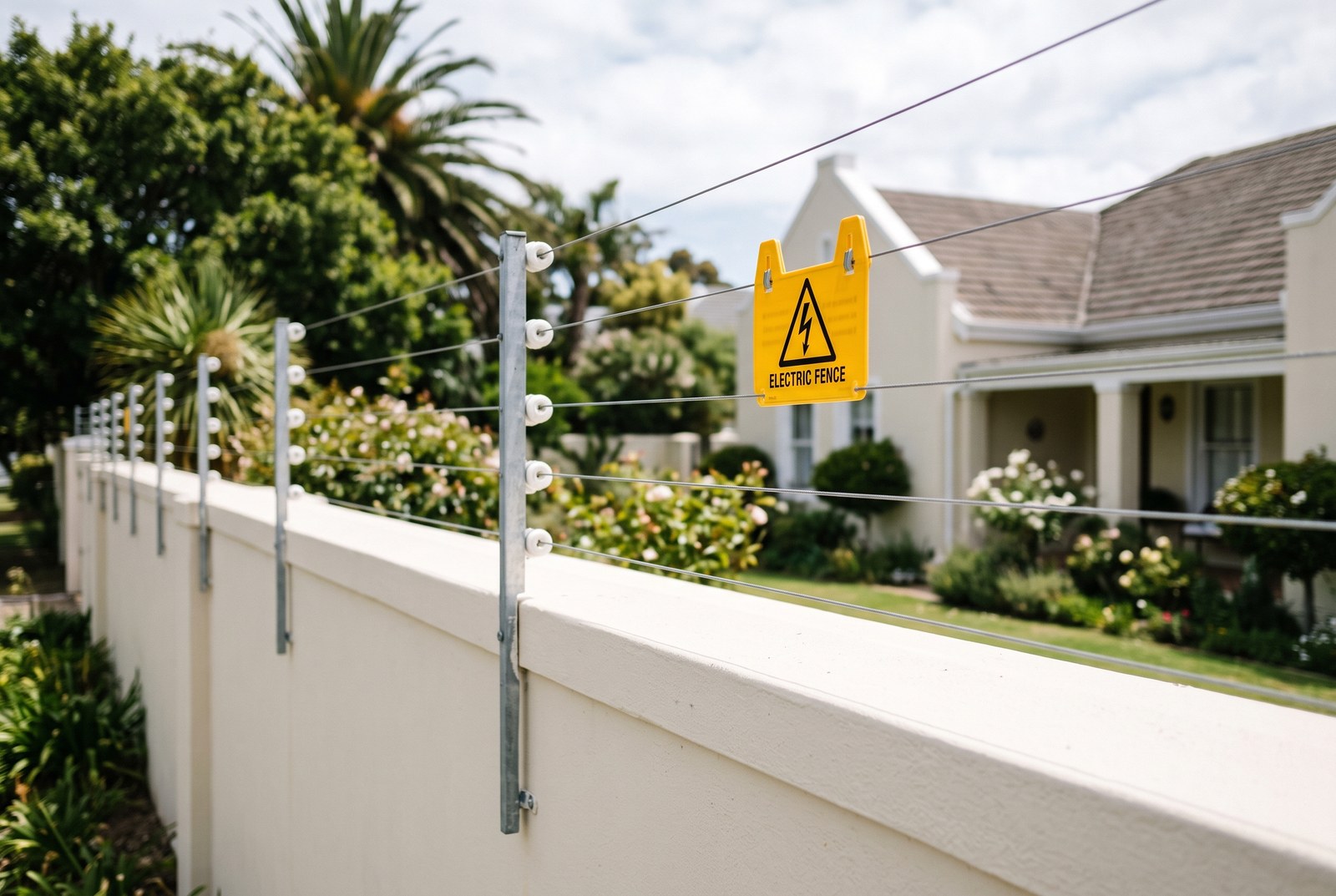
- SANS 10222-3 compliant warning signs: black-and-yellow, correct dimensions, correct text
- Signs at every access point (every gate, entrance, pedestrian access)
- Signs at maximum 10m intervals along the full fence perimeter
- Signs correctly mounted — visible from both sides where required
- No gaps in warning sign coverage around the perimeter
Our 5-Step Electric Fence CoC Process
Electric Fence CoC Cost in Cape Town (2026)
An electric fence Certificate of Compliance in Cape Town costs from R500 for a small property with up to 50m of fence, with longer runs and multi-zone systems priced on scope — with remediation charged only if faults are found. Bundle several certificates of compliance in one visit to save up to 22%. See the full price breakdown below.
| Property Type | Inspection + CoC (Pass) | Typical Remediation |
|---|---|---|
| Small property (up to 50m fence) | R500 – R750 | Warning signs + spikes (on-site): R200–R600 |
| Standard house (50–200m fence) | R700 – R1,000 | Energizer replacement: R1,500–R4,000 |
| Large property / estate (200m+) | R900 – R1,200 | Fence re-stringing: R1,500–R3,500+ |
| Complex / multiple energizer zones | R1,000 – R2,000+ | Quoted on scope |
6 Most Common Electric Fence CoC Failures in Cape Town
- Missing or non-compliant warning signs — the most common failure. Signs must be the correct size (minimum 75mm × 100mm per SANS 10222-3), correct colours (black text and border on yellow background), correct text, and must appear at every access point AND at maximum 10m intervals along the perimeter. Many installations have insufficient sign coverage or incorrect sign designs.
- Insufficient earth spikes — SANS 10222-3 requires a minimum of 3 earth spikes plus 1 additional spike per 30m of fence. Many older installations have only 1 or 2 spikes.
- Vegetation touching live wires — one of the most common practical failures in established Cape Town gardens. Trees, shrubs, and climbing plants grow into the fence over time, causing continuous discharge and reducing effectiveness. Vegetation must be cleared to at least 50mm from all live wires.
- Energizer not on SANS/IEC-listed models list — older or informally imported energizers may not appear on the approved models list. The EFSI inspector verifies every energizer against the current approved list.
- Fence height below SANS minimum — the fence must extend at least 1.5m above the top of the wall (for wall-mounted fences) or 450mm above the boundary line (for freestanding fences). Extensions to existing walls sometimes result in the fence height falling below the required level.
- Output voltage exceeding SANS limits — fence voltage must not exceed 10,000V (10kV) at any point. Oversized or incorrectly programmed energizers may exceed this limit.
Frequently Asked Questions — Electric Fence CoC Cape Town
My electric fence was installed before October 2012 — do I still need a certificate?
Yes — all property transfers involving electric fencing require a valid EFSCC regardless of when the fence was installed. A fence that has not been modified since 2012 can be certified as an existing installation — it will be assessed against current SANS 10222-3 requirements. Pre-2012 installations often fail initially due to incorrect warning signs and insufficient earth spikes, both of which are easily and inexpensively rectified.
How long is an Electric Fence CoC valid?
2 years from the date of issue, provided no modifications are made to the fence system. Any extension, repair, re-stringing, energizer replacement, or modification — however minor — invalidates the existing certificate and requires a new inspection and EFSCC.
Can the person who installed my fence issue the certificate?
Yes — a registered EFSI may both install and certify their own work under South African law. However, for existing fences where there is uncertainty about compliance, using an independent EFSI inspector provides an objective assessment before committing to repairs. All our inspectors are independent — we do not do fence installation, only inspection and certification.
What are the legal consequences of operating a fence without an EFSCC?
Under the OHS Act, operating an electric fence without a valid EFSCC constitutes a criminal offence. More significantly, if a person is injured by the fence — whether trespasser, visitor, or contractor — the property owner faces potentially unlimited personal liability for damages if no valid EFSCC is in force at the time of injury. Most short-term insurers decline claims related to fence incidents without a valid EFSCC in place.
Does the electric fence energizer need to be a specific brand or model?
Yes — the energizer must appear on the SANS/IEC approved energizer list maintained by the South African Bureau of Standards. Common approved brands in Cape Town include Nemtek, Stafix, Gallagher, DSC, and Risco — among many others. Older models or informally imported units may not appear on the current list. An energizer that is not on the list must be replaced with an approved model before an EFSCC can be issued.
Do I need a separate EFSCC for each zone if I have a multi-zone energizer?
No — a single EFSCC covers the complete electric fence installation including all zones connected to the same or multiple energizers at a single property. The certificate lists all energizers, the total fence perimeter covered, and all zones. Each zone is separately assessed during the inspection and all are reflected on the one certificate.
My fence shares a boundary wall with my neighbour — who is responsible for the EFSCC?
Responsibility follows the ownership of the energizer and fence installation. You are responsible for the EFSCC covering that section when your energizer powers the fence on the shared boundary. Where a boundary fence is jointly owned and both parties share an energizer, the matter should be resolved between the parties and your conveyancer advised of the arrangement. In practice, each party is usually responsible for the fence installation on their own property side.
What are the regulations for electric fences in South Africa?
Electric fences fall under the Occupational Health and Safety Act 85 of 1993 and the Electrical Machinery Regulations of 2011, with SANS 10222-3 as the technical standard. Any system installed on or after 1 October 2012 needs a valid Electric Fence System Certificate of Compliance, and an older system needs one at change of ownership. Only an installer registered with the Department of Employment and Labour as an Electric Fence System Installer may issue that certificate. The standard governs energizer output, warning-sign placement, fence height and clearances, earthing, and isolation from the mains supply.
Book Your Electric Fence CoC Inspection — Cape Town
Registered EFSI inspectors · Warning signs & earth spikes supplied on-site · Registered, standards-based inspections · Full Cape Town metro
Electric Fence CoC — Areas We Serve Across Cape Town
Our EFSI-registered Electric Fence System Installers issue electric fence Certificates of Compliance across the Cape Town metro, with warning signs and earth spikes supplied on site and your certificate emailed within 24 hours of a pass. Find your area for a local electric fence CoC inspection.