
Plumbing Certificate of Compliance in Cape Town, Western Cape
Book a City of Cape Town-registered plumber to test your fixed water installation against SANS 10252-1 and the City Water By-law. The plumber signs the City’s water installation certificate, your conveyancer submits it before transfer, and a new plumbing CoC is needed for every sale.
Get a Free Plumbing CoC Quote — Fast
Tell us what you need and we’ll send your price now.
Prefer to talk? Call 071 293 2423
✔ Registered, Compliant & Accepted
Every plumbing CoC we arrange is issued and signed off by a City of Cape Town-registered plumber in line with the City of Cape Town Water By-law and SANS 10252/10254. The issuing professional’s registration number appears on your certificate, so it is fully verifiable and accepted by conveyancers, banks and the Deeds Office. We only work with correctly registered plumbers — a certificate from an unregistered person is not valid.
A plumbing certificate of compliance (plumbing CoC) in Cape Town confirms your fixed water installation meets the City Water By-law and SANS 10252-1. A City of Cape Town-registered plumber inspects the property and signs the certificate, and your conveyancing attorney submits it to the City before transfer. A new certificate is needed for every sale, and the inspection runs R500 to R1,200, averaging about R750.
- City of Cape Town-registered plumbers on every inspection — registration number provided upfront
- City of Cape Town Water By-law compliance — Plumbing CoC issued on the City’s official form, the Certificate of Compliance of Water Installation on Transfer of Ownership (Schedule 4)
- Signed certificate emailed to you and your conveyancer, ready to submit to [email protected]
- Calibrated pressure gauges (0–1,600 kPa range) and electronic acoustic leak detection on every inspection
- PRV, vacuum breaker, and overflow pipe repairs completed on-site in most cases — same-day resolution
- Itemised fault report with fixed-price remediation quote within 2 hours of inspection
- R5 million public liability insurance on all plumbing work
- Serving all City of Cape Town suburbs including Somerset West, Strand, Gordon’s Bay, and the full Northern Suburbs belt
In short: a plumbing certificate of compliance in Cape Town — the City’s water installation certificate — confirms your fixed water installation meets SANS 10252-1 and the City of Cape Town Water By-law. It may only be issued by a plumber registered with the City of Cape Town, and the City requires it before a property in the metro transfers.
What Is a Plumbing Certificate of Compliance?
A Plumbing Certificate of Compliance (Plumbing CoC or Water CoC) is a legal document confirming that the water supply and drainage installations on your property comply with the City of Cape Town Water By-law, 2010 (Section 14). It may only be issued by a City of Cape Town-registered plumber — a plumber holding a valid registration number issued by the City’s Water and Sanitation Department (not simply a PIRB or IOPSA qualification).
This certificate is unique to the City of Cape Town. It is required under Section 14 of the City’s Water By-law. Within the City’s approximately 2,460 km² boundary — from Atlantis in the north to Gordon’s Bay in the east and Noordhoek in the south — the Plumbing CoC is as legally non-negotiable as the Electrical CoC.
The City introduced the certificate to make sure the water installation complies with the City water by-laws and the National Building Regulations and Building Standards Act 103 of 1977. It certifies that the water meter registers consumption, that no stormwater discharges into the sewer, and that there is no cross-connection between drinking water and any greywater, recycled water or groundwater system. The conveyancing attorney submits the completed certificate to the City at [email protected] before transfer registration, and a City water inspector checks selected properties afterwards.
Plumbing CoC Legal Framework: the Water By-law and the Schedule 4 Form
The Plumbing Certificate of Compliance certifies that the property’s fixed water installation meets SANS 10252-1 (water supply installations) and SANS 10254 (fixed electric storage water heaters / geysers), read with the National Building Regulations (SANS 10400) and the national Water Services Act 108 of 1997. Under the City of Cape Town Water By-law (2010), the inspecting plumber must confirm that the water meter registers correctly with no unmetered supply, that there is no cross-connection between potable and non-potable (borehole or grey) water, that no stormwater discharges into the sewer, that the geyser has a working pressure-control safety valve, vacuum breaker and overflow / drip tray, and that all fittings are leak-free. The certificate may only be issued by a City of Cape Town-registered plumber — a PIRB or IOPSA qualification alone is not sufficient.
Section 14 of the Water By-law, as amended in 2018, puts the duty on the seller: “The seller must before transfer of a property, submit a certificate of compliance from a registered plumber”. The form is the City’s Certificate of Compliance of Water Installation on Transfer of Ownership (Schedule 4, PDF). Section 14(3) makes false information on the certificate an offence, punishable under section 64 by a fine or up to five years’ imprisonment. Under section 46A the City may strike a plumber off its register for falsely completing a certificate, and the City considers re-registration only after 12 months.
What the Plumbing Inspection Covers
The City of Cape Town’s official form, the Certificate of Compliance of Water Installation on Transfer of Ownership (Schedule 4), has seven checks. The City-registered plumber signs to confirm that each one passes:
- Geyser (hot water cylinder) — the installation must comply with SANS 10252 and SANS 10254: a working pressure control valve, safety valve and vacuum breakers, overflow pipes that discharge visibly outside, and a drip tray where one is required. Geysers installed before 2006 are not failed for having no drip tray.
- Water pipes — pipes, especially in the roof space, must be properly saddled (clipped in place) as per SANS 10252.
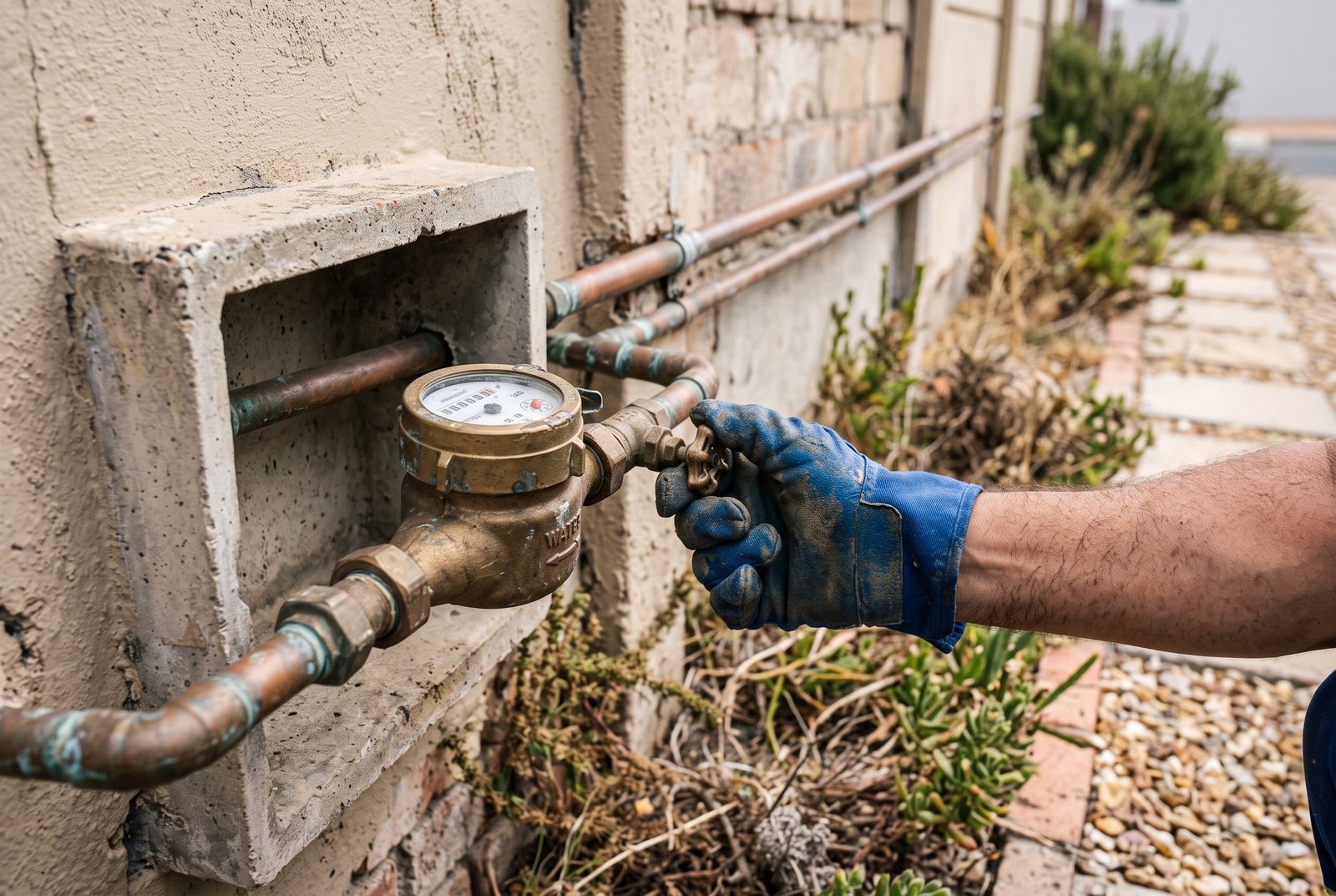
- Water meter — the meter must register flow when water is drawn and stop when all taps are closed. A meter that keeps turning with everything off points to a hidden leak. A Cape Town field study published in Water SA (2015) found on-site leaks at 17.1% of 402 homes tested, with a median rate of 10 litres an hour, and leaks under about 5 litres an hour were too small for the meter to register.
- Private isolating valve (stoptap) — the property’s own isolating valve must be in place and working, as required by subsection 23(2) of the Water By-law.
- Taps and other terminal fittings — no tap, shower, mixer or toilet cistern may leak, and each must be fixed firmly in position.
- Stormwater — no stormwater from gutters, downpipes or paved areas may discharge into the sewer system.
- Cross-connections — there must be no connection between the municipal drinking-water supply and any alternative supply, such as a borehole, rainwater tank, grey water or recycled water. If one exists, the fix is to disconnect it so the alternative supply runs on its own pipes.
What the Plumbing CoC Does Not Cover
The City states that the certificate covers only what is on its checklist. It is not a full plumbing report: blocked drains, waste pipes and traps under basins, low water pressure and cosmetic damage such as a cracked basin are outside it.
The legal basis is printed on the form itself: the City’s Water By-law 2010 and Water Amendment By-law 2018 (Section 14(1)), and the Wastewater and Industrial Effluent By-law 2013 (Section 2(2)(a)).
Our 5-Step Plumbing CoC Process
Plumbing CoC Cost in Cape Town (2026)
A plumbing Certificate of Compliance in Cape Town costs from R500, depending on property size and certificate scope — with remediation charged only if faults are found. Bundle several certificates of compliance in one visit to save up to 22%. See the full price breakdown below.
| Property Type | Inspection + CoC (Pass) | Common Remediation |
|---|---|---|
| Apartment (1 geyser) | R500 – R750 | PRV + vacuum breaker: R900–R1,600 |
| House (1–2 geysers) | R750 – R1,000 | Tap replacement: R300–R800 per tap |
| Large home (3+ geysers) | R1,000 – R1,200 | Overflow re-pipe: R600–R1,400 |
| Storm water re-routing | Included in inspection fee | R1,500–R6,000 (scope dependent) |
All remediation costs are fixed-price and quoted in writing before work begins. Book the inspection once the offer to purchase is signed, so any repairs are done before your conveyancer lodges the transfer.
7 Most Common Plumbing CoC Failures in Cape Town
- Missing or faulty PRV — the most common failure on older homes. The City’s design standard allows up to 90 m of head (about 880 kPa) in the street main at zero flow, close to the 900 kPa national ceiling in regulation 15 of the national water regulations (GN R509 of 2001). A PRV brings that down to the geyser’s rated pressure, typically 400 or 600 kPa.
- No vacuum breaker on geyser cold supply — required to prevent contaminated water syphoning back into the potable supply when mains pressure drops.
- Incorrect overflow pipe routing — overflow must discharge to a clearly visible external point so occupants can see if the geyser is overflowing. Overflows discharging into walls or cavities fail.
- Leaking taps, mixers, or cisterns — even a single dripping tap (approximately 40–50 litres/day) constitutes a Water By-law non-compliance.
- Inaccessible or seized stoptap — the private isolation valve must be locatable and working (Water By-law subsection 23(2)). An owner who cannot find their own stopcock pays the City R1,391.20 to shut off the supply for repairs (2026/27 tariff).
- Storm water discharging into sewer — particularly in pre-1970 properties where gutters were often plumbed into the sewage system rather than to the kerb or soakaway. The City gives three months’ notice, then levies a surcharge of R33.60 per m² of roof or paved area each month (2026/27 tariff) until the connection is fixed.
- Unmarked supplementary water connections — every outlet on a borehole, rainwater or grey water supply must carry a weatherproof notice, in English, Afrikaans and isiXhosa, that the water is unsuitable for domestic purposes (Water By-law section 61). A plumbed-in alternative supply needs a reduced pressure zone (RPZ) backflow preventer, which the City’s Guidelines for Alternative Water Installations call “mandatory”.
Frequently Asked Questions — Plumbing CoC Cape Town
Is a Plumbing CoC required outside the City of Cape Town?
No — the Plumbing CoC applies only within the City of Cape Town municipal area under Section 14 of the City’s Water By-law, 2010. Other municipalities do not use this certificate. Within the City’s boundaries — which include Somerset West, Strand, Brackenfell, Table View, and all suburbs between — the Plumbing CoC is mandatory for every property transfer regardless of property type or value.
How long is a Plumbing CoC valid?
No fixed expiry — a Plumbing CoC is tied to one transfer. A new certificate is needed each time the property is sold, and most conveyancers want one issued shortly before registration.
Where must the Plumbing CoC be submitted?
Your conveyancing attorney submits the completed certificate to the City of Cape Town at [email protected] before transfer. The City’s Customer Service Charter (2026) commits to responding to a transfer CoC within 3 working days and resolving it within 10 working days, provided all documentation is received. We email the signed certificate to you, your estate agent and your conveyancer at the same time, so nothing holds up lodgement.
Can any plumber issue a Plumbing CoC?
No — only a plumber with a valid City of Cape Town Plumbing Registration Number may legally issue a Plumbing CoC. This is separate from a PIRB (Plumbing Industry Registration Board) or general trade qualification. Always verify City registration before booking. To register, the City asks for a certified copy of the plumber’s Plumbing Trade Test Certificate or an existing permanent City plumbing licence, and it publishes its register of plumbers, which ran to 118 pages in September 2026. All our plumbers carry their City registration numbers, which are printed on every certificate.
What does a PRV supply and fit cost?
A complete PRV supply and installation typically costs between R900 and R1,600 depending on access difficulty, existing pipework configuration, and whether an isolating valve and pressure gauge are fitted simultaneously. The PRV is set to suit the geyser’s rated pressure, usually 400 or 600 kPa. Many older Cape Town homes have never had a PRV installed, particularly in areas that historically had low mains pressure — though mains pressure has increased in many suburbs as the network has been upgraded.
Does a solar geyser or heat pump need a Plumbing CoC?
Yes — solar geysers and heat pump water heaters are covered by the inspection. Cold water supply connections, pressure controls (PRV, vacuum breaker), and overflow provisions must comply with the Water By-law regardless of the geyser’s energy source. Correctly installed solar geysers — especially those installed professionally after 2010 — generally comply easily.
Is the Plumbing CoC the same as a drain camera inspection?
No — the Plumbing CoC covers the water supply system and hot water installation for compliance with the City By-law. It does not cover drain blockages, drain camera inspections, or the structural condition of sewer lines. Blocked or damaged drains are a separate maintenance issue. Address drainage problems independently as they may affect marketability even if they do not fail the Plumbing CoC.
How much water does a dripping tap waste?
A single dripping tap wastes approximately 40–50 litres per day (15,000–18,000 litres per year). A running toilet cistern wastes up to 200 litres per day. This is precisely why the City By-law requires all leaks to be repaired before a certificate can be issued. Fixing all visible drips before your inspection is one of the simplest ways to pass first time.
Does a borehole affect my Plumbing CoC?
Yes — if your borehole is connected to the household plumbing, it must have: (1) a reduced pressure zone (RPZ) backflow preventer, or an air-gap tank, to stop borehole water entering the municipal supply, which the City’s alternative-water guidelines describe as “mandatory”; (2) a weatherproof notice on every outlet, in the Province’s three official languages, that the water is unsuitable for domestic purposes; and (3) correct isolation from the potable water system. An unprotected borehole connection constitutes a cross-connection non-compliance. The Water By-law requires the borehole to be registered on the City’s database, with the City’s sign displayed on the property. A borehole pumping only to a separate garden irrigation system with no household connection typically does not affect the CoC.
What if my geyser is faulty — does it need to be replaced for the CoC?
A leaking geyser tank (corroded or cracked) typically requires replacement before a certificate can be issued — it is both a water wastage and a safety issue. A continuously open safety valve suggests either the PRV pressure setting is too high or the safety valve itself needs replacement — both are correctable without replacing the geyser. We assess and advise on the most cost-effective solution during inspection, and can arrange emergency geyser replacement through our preferred plumbing suppliers at competitive rates.
What are the requirements for a plumbing CoC in Cape Town?
To pass, the fixed water installation must comply with SANS 10252-1 and the City of Cape Town Water By-law: the water meter must register accurately with no unmetered supply, there must be no cross-connection between potable and borehole or grey water, no stormwater may drain into the sewer, the geyser must have a working safety valve, vacuum breaker and overflow/drip tray (per SANS 10254), and all fittings must be leak-free.
How do I get a plumbing certificate of compliance?
Book a City of Cape Town-registered plumber to inspect your fixed water installation. We confirm your appointment within about 2 hours, inspect against SANS 10252-1 and the City Water By-law, carry out any minor remedials, and email your Plumbing CoC within 24 hours of a pass. Call 071 293 2423 or request a quote above to start.
How long is a plumbing CoC valid for in Cape Town?
Unlike an electrical CoC, the City of Cape Town’s plumbing (water installation) Certificate of Compliance is transaction-based: a valid certificate is required each time a property is sold and transferred. There is no fixed multi-year expiry, but if plumbing work is done after issue, a fresh certificate is needed for the next transfer — most conveyancers require one issued shortly before registration.
Is a plumbing CoC compulsory when selling a property in Cape Town?
Yes. The City of Cape Town Water By-law makes a plumbing (water installation) Certificate of Compliance compulsory before a property transfer can register within the City’s boundaries. It is separate from, and additional to, the electrical CoC required nationally under the OHS Act.
Book Your Plumbing CoC Inspection — Cape Town
City-registered plumbers · Certificate sent to your conveyancer · Registered, standards-based inspections · Full Cape Town metro coverage
Plumbing CoC — Areas We Serve in Cape Town
Our City of Cape Town-registered plumbers issue plumbing Certificates of Compliance across the metro.