
Solar Panel Certificate of Compliance in Cape Town, Western Cape
Solar PV & inverter CoC for property transfers · SSEG registration support · SANS 10142-1 compliant · Updated Electrical CoC issued same day on pass
Get a Free Solar CoC Quote — Fast
Tell us what you need and we’ll send your price now.
Prefer to talk? Call 071 293 2423
✔ Registered, Compliant & Accepted
Every solar PV CoC we arrange is issued and signed off by a Department of Employment and Labour (DoEL)-registered electrician in line with SANS 10142-1, with City of Cape Town SSEG registration where grid-tied. The issuing professional’s registration number appears on your certificate, so it is fully verifiable and accepted by conveyancers, banks and the Deeds Office. We only work with correctly registered electricians — a certificate from an unregistered person is not valid.
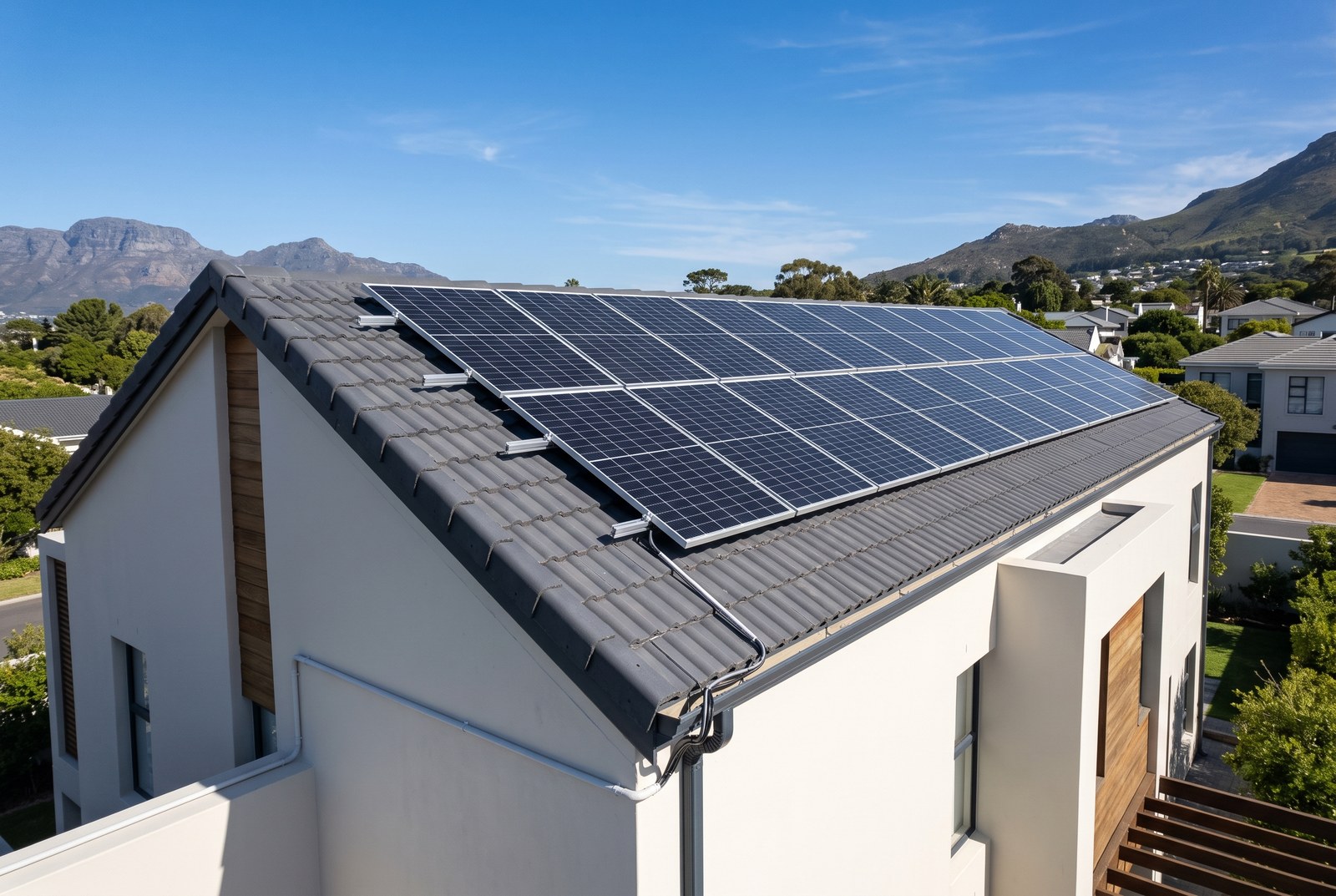
A solar certificate of compliance covers your PV panels, inverter and battery wiring, and in Cape Town it is issued as an updated electrical CoC against SANS 10142-1. Grid-tied systems also need SSEG registration with the City. Budget from R1,500, rising to R3,500 or more on larger systems, and it stays valid for two years.
COC Certificate delivers electrical compliance inspections across Cape Town. With the explosion of residential solar PV and inverter installations during the 2022–2024 load shedding period, solar-related CoC issues have become one of the most common reasons property transfers are delayed in the Cape Town metro. Our DoEL-licensed electricians are specifically trained in SANS 10142-1 solar PV compliance and provide complete solar CoC services — from inspection and certificate issuance through to City of Cape Town SSEG registration support.
- DoEL-licensed electricians with specific SANS 10142-1 solar PV installation experience
- Registered electrical compliance inspections — solar CoC services since the 2019 grid-tied regulation updates
- Certificates issued within the validity window — we understand transfer deadline urgency
- Full SANS 10142-1 test sequence using calibrated Megger MFT1735 and Fluke 1587FC instruments
- DC circuit insulation resistance testing (up to 1,000V DC), AC circuit testing, and SSEG anti-islanding verification
- Thermal imaging of all DC connections and inverter — hotspot detection on panel connectors and string combiners
- SSEG registration documentation prepared and submitted to the City of Cape Town on your behalf
- Inverter approved-list verification — we confirm your inverter appears on the SABS/City approved list
- Same-day certificate issuance on pass — complete Electrical CoC including solar system details issued same day
- R5 million public liability insurance on all electrical work
In short: a solar certificate of compliance (solar CoC) in Cape Town certifies that your grid-tied solar PV installation is electrically safe and compliant with SANS 10142-1. It forms part of the property’s electrical CoC, must be issued by a DoEL-registered electrician, and grid-tied systems require City of Cape Town SSEG registration.
Solar Certificate of Compliance for Cape Town Property Transfers — What You Need to Know
South Africa’s load shedding crisis drove an estimated 800,000 residential rooftop solar PV systems installed nationally between 2022 and 2024. In Cape Town alone, it is estimated that more than 15% of residential properties now have some form of solar or battery backup system installed (City of Cape Town SSEG statistics, 2024). As these properties now come to market, solar compliance has emerged as one of the most frequently identified issues in Cape Town property transfers.
A solar PV system or inverter connected to the fixed electrical installation is governed by SANS 10142-1 (Wiring of Premises) and must appear on the property’s Electrical Certificate of Compliance. It is not a separate CoC type — it forms part of the Electrical CoC. However, if a solar system was installed after the most recent Electrical CoC was issued, that CoC is no longer valid and a new Electrical CoC covering the solar installation is required before transfer.
Additionally, grid-tied systems (those that can feed power back to the City of Cape Town’s grid) require separate SSEG (Small-Scale Embedded Generator) registration with the City. Without SSEG registration, a grid-tied system is technically operating illegally on the City’s network — a fact that is increasingly being flagged by conveyancers and buyers’ attorneys.
Does My Solar Installation Require a New Electrical CoC?
| Your Situation | New CoC Required? |
|---|---|
| Solar system installed AND Electrical CoC issued within last 2 years covering the solar system, no changes since | ✅ Existing CoC valid — verify it includes solar |
| Solar/inverter installed AFTER the most recent Electrical CoC was issued | ❌ New CoC required |
| Solar installed but no Electrical CoC was ever issued to cover it | ❌ New CoC required |
| Hardwired battery/inverter with no panels (e.g. Victron, Pylontech), connected to DB board | ❌ New CoC required |
| Portable plug-in inverter (plugged into wall socket, not hardwired) | ✅ No CoC required for the inverter itself |
| Existing Electrical CoC more than 2 years old (regardless of solar) | ❌ New CoC required regardless |
| Grid-tied system not registered as SSEG with the City of Cape Town | ⚠ SSEG registration required separately |
What the Solar CoC Inspection Covers
- Panel mounting — structural integrity and correct rafter loading
- DC cabling — correct UV-resistant, double-insulated solar cable type
- DC cable insulation resistance tested at 500V DC per string
- DC isolator switch at panel level (roof) and at inverter
- String combiner box fusing and labelling (multi-string systems)
- Panel and array earthing and bonding per SANS 10142-1
- Inverter make and model — verified on SABS/City approved list
- AC isolator switch and MCB protection verified and correctly rated
- Anti-islanding protection — tested per SANS 10142-1 requirements
- DB board integration — correct labelling, protection, and documentation
- AC cabling — correct rating and installation throughout
- System labelling — all DC and AC components labelled per SANS 10142-1
- Battery type and installation location assessment
- Ventilation for lithium-ion (LiFePO4) and lead-acid battery types
- Battery Management System (BMS) certification status
- DC disconnect and fusing — correct ratings for battery capacity
- Fire risk assessment of battery enclosure
- SSEG application to City of Cape Town prepared
- Confirmation of grid-tied vs. non-export vs. off-grid configuration
- Generation meter installation requirements assessed
- Net metering agreement eligibility
- City approval documentation for buyer’s conveyancer
Our 6-Step Solar CoC Process
Solar CoC Cost in Cape Town (2026)
A solar PV / SSEG Certificate of Compliance in Cape Town costs from R1,500, depending on property size and certificate scope — with remediation charged only if faults are found. Bundle several certificates of compliance in one visit to save up to 22%. See the full price breakdown below.
| System Type | Solar CoC (Pass) | Typical Remediation |
|---|---|---|
| Inverter only (no panels, hardwired to DB) | R1,500 – R2,000 | Isolator switch: R800–R1,500 |
| Solar PV system up to 3kWp | R1,800 – R2,500 | DC cable replacement: R1,500–R4,000 |
| Solar PV system 3–10kWp | R2,200 – R3,500 | Labelling + isolators: R500–R2,000 |
| Large system with battery storage (10kWp+) | R3,000 – R5,000+ | Quoted on scope |
| SSEG registration (City of Cape Town) | R500 – R800 (add-on) | Included in service |
6 Most Common Solar CoC Issues in Cape Town Property Transfers
- No CoC was issued at the time of installation — many solar installations during the 2022–2024 load shedding peak were installed by unlicensed contractors or informal installers who never obtained a CoC. This is the most common scenario encountered in Cape Town property transfers involving solar.
- Existing Electrical CoC predates the solar installation — any CoC issued before the solar panels/inverter were installed is no longer valid for transfer purposes.
- Grid-tied system not registered as SSEG — the City of Cape Town requires SSEG notification/approval for all grid-tied systems. Many homeowners are unaware this is separate from the electrical CoC requirement.
- Incorrect DC cabling specification — DC cables must be UV-resistant, double-insulated solar cable (typically marked SOLAR or PV1-F) rated for outdoor/roof use. Standard TPS or flex cable, commonly substituted during rush installations, is non-compliant.
- Missing roof-level DC isolator — a DC isolator switch at panel/array level (in addition to the inverter-level DC switch) is required per SANS 10142-1 to allow safe isolation of the DC circuit at the roof without accessing the inverter.
- Inverter not on SABS/City approved list — some inverters installed during the loadshedding rush were low-cost imported units not tested to South African standards. An inverter that is not on the approved list must be replaced before the solar CoC can be issued.
Frequently Asked Questions — Solar CoC Cape Town
Does my solar system need to be registered with the City of Cape Town?
Yes, if your system is grid-tied — meaning it can feed power back to the City’s electricity network. All grid-tied systems must be registered as a Small-Scale Embedded Generator (SSEG) with the City of Cape Town. The City requires this for all grid-tied systems regardless of size. Off-grid systems (no grid connection) and systems with automatic transfer switches that prevent any back-feeding do not require SSEG registration.
My solar system was installed by a well-known company — is it definitely compliant?
Not necessarily — even installations by larger companies sometimes contain non-compliances, particularly: missing roof-level DC isolators, missing system labelling, or DC cabling that does not meet the UV-resistance requirements of SANS 10142-1. Additionally, even a fully compliant installation will require a new Electrical CoC if the existing one has expired or was issued before the solar was installed. We recommend a pre-transfer solar compliance audit regardless of the installer’s reputation.
What is the difference between a Solar CoC and SSEG registration?
The Solar CoC (updated Electrical CoC) confirms the installation meets SANS 10142-1 wiring safety standards — it is a safety document. The SSEG registration is a City of Cape Town utility management process for grid-tied systems — it is an administrative document confirming the City is aware of and has approved the grid connection. Both may be required, but they are separate documents issued by different authorities. We handle both as part of our complete solar compliance service.
How long does the SSEG registration process take?
The City of Cape Town’s SSEG approval process typically takes 5–15 business days from submission of a complete application. Incomplete applications can take significantly longer. We prepare and submit a complete application on your behalf, minimising delays. Start the SSEG registration process as early as possible when your transfer timeline is tight — ideally at the same time as the electrical inspection.
Does the buyer become responsible for SSEG registration?
The SSEG registration is typically tied to the property, not the individual. When a property transfers, the new owner must update the SSEG registration with the City in their name. We advise both sellers and buyers on the SSEG handover process to ensure continuity of the grid-tied system’s legal status after transfer.
Can I still use my solar system during the transfer process?
Yes — you may continue using your solar system during the transfer process. The compliance inspection and CoC issuance does not require the system to be switched off for any extended period (only briefly during testing). The transfer process does not legally require the system to be deactivated at any stage. Ensure all systems are operational and accessible on inspection day.
Solar CoC & SSEG Registration — Cape Town
Complete solar compliance service · DoEL registered · Thermal imaging included · Fast turnaround for transfer deadlines
Solar CoC — Areas We Serve Across Cape Town
We issue solar certificates of compliance and handle SSEG registration across the whole City of Cape Town metro. Every suburb page below covers the solar CoC alongside the other certificates your transfer may need.
Book Your Gas CoC Inspection — Cape Town
SAQCC Gas registered · SANS 10087-1 compliant · Registered, standards-based inspections · Fast turnaround for transfer deadlines