
Gas Certificate of Compliance in Cape Town, Western Cape
Book a SAQCC Gas-registered installer to test every permanently installed LPG appliance against SANS 10087-1 and issue your gas CoC on the day it passes. A new gas CoC is issued for every change of ownership, across the full Cape Town metro.
Get a Free Gas CoC Quote — Fast
Tell us what you need and we’ll send your price now.
Prefer to talk? Call 071 293 2423
✔ Registered, Compliant & Accepted
Every gas CoC we arrange is issued and signed off by a SAQCC Gas-registered gas installer in line with SANS 10087-1. The issuing professional’s registration number appears on your certificate, so it is fully verifiable and accepted by conveyancers, banks and the Deeds Office. We only work with correctly registered installers — a certificate from an unregistered person is not valid.
A gas certificate of compliance in Cape Town covers every permanently installed LPG appliance, and may only be issued by a SAQCC Gas-registered installer working to SANS 10087-1. The certificate is issued the day the installation passes, and a new one is required at every change of ownership. Budget about R850, within a R750 to R950 range.
COC Certificate issues Gas Certificates of Compliance for Cape Town property transfers. We have assisted property sellers, buyers, and estate agents in obtaining their Gas CoC on time. With every inspection conducted by a SAQCC Gas-registered installer, we ensure your gas compliance certificate is legally valid, thoroughly issued, and never holds up your transfer.
- SAQCC Gas-registered installers on every inspection — registration numbers verifiable
- Registered gas compliance inspections for Cape Town property transfers —
- Certificates issued the day the installation passes, timed to your transfer date
- Calibrated manometer pressure tests (0–35 kPa range) on every gas circuit to SANS 10087-1 specification
- Electronic combustible gas detector used to check all fittings and joints for micro-leaks invisible to soapy water testing
- Ventilation compliance measured — floor-level air bricks and door gap sizes verified against SANS 10087-1 minimums
- Flexible hose inspection — hoses older than 5 years flagged for replacement as precaution
- Itemised fault report and fixed-price remediation quote within 2 hours of inspection
- We stock common hoses, regulators, and fittings for same-day minor repairs in most cases
- R5 million public liability insurance on all gas work
In short: a gas certificate of compliance in Cape Town confirms every permanently installed LPG appliance and its fixed pipework meets SANS 10087-1. It may only be issued by a SAQCC Gas-registered installer, and Regulation 17(3) of the Pressure Equipment Regulations, 2009 requires a new certificate of conformity at every change of ownership.
What Is a Gas Certificate of Compliance?
A Gas Certificate of Compliance (Gas CoC) is a legal document confirming that all permanent LPG (Liquefied Petroleum Gas) appliance installations on a property comply with SANS 10087-1: The handling, storage, distribution and use of liquefied petroleum gas in domestic, commercial and industrial installations. It may only be issued by a registered gas installer who holds a valid SAQCC Gas registration. It is commonly known as a gas installation certificate or gas Certificate of Conformity (CoC).
Gas installations have become extremely common in Cape Town homes over the past decade, driven by Eskom load shedding and a preference for gas cooking. Gas hobs, gas ovens, gas fireplaces, gas water heaters, patio heaters, and outdoor braais with gas connections are all now standard in many Cape Town properties. Any of these permanently installed appliances — connected to fixed LPG pipework — require a valid Gas CoC at property transfer.
Important: Portable LPG appliances (free-standing gas braais, portable heaters connected to small portable cylinders) do not require a Gas CoC. Only appliances connected to fixed, permanent LPG pipework require certification. However, if there is any doubt, disclose all gas appliances to your inspector.
Gas is more common in Western Cape homes than in any other province. According to Statistics South Africa’s General Household Survey 2025, 22.1% of Western Cape households cook mainly with gas, or 499,000 households, against 9.4% nationally. Each of those homes with a hob or appliance on fixed pipework needs a Gas CoC when it is sold.
Standards & Legal Framework
A gas CoC is not optional paperwork. Regulation 17(3) of the Pressure Equipment Regulations, 2009 (GN R.734), promulgated under the Occupational Health and Safety Act 85 of 1993, states that an authorised person “shall issue a certificate of conformity after completion of a gas installation, modification, alteration or change of user or ownership”. The Department of Labour’s Guidance Notes to the Pressure Equipment Regulations (Revision 2, 2017) add that “the seller is responsible for obtaining a Certificate of Conformity”. Regulation 6(2)(e) gives the user a standing duty to ensure the gas system “has a valid certificate issued by an authorised person”.
The installation itself is measured against SANS 10087-1, which sets the minimum requirements for handling, storage, distribution and use of LPG. Government Notice R.262 of 2017 lists SANS 10087-1 in the schedule of the Pressure Equipment Regulations, which gives the standard the force of law. The certificate may only be signed by an installer holding current SAQCC Gas registration. Their registration number appears on your certificate and can be verified before you book. The City of Cape Town adds one local rule: under section 37(6) of its Community Fire Safety By-law, storing or using more than 100 kg of flammable gas needs a flammable substance certificate from the City.
SAQCC Gas Registration — Who May Legally Issue Your Gas CoC
SAQCC Gas is the South African Qualification and Certification Committee for Gas, the body that registers gas practitioners. A Gas Certificate of Compliance signed by a person without current SAQCC Gas registration is not a valid certificate, and a conveyancer who spots it will hold up the transfer until a proper one is issued. SAQCC Gas accepts only electronic certificates: its notice of February 2023 states that any CoC issued on paper from 1 April 2023 “will not be considered valid”.
The registration card, and why the category matters
Every registered practitioner carries an SAQCC Gas registration card showing three things — a registration number, a gas category, and an expiry date. The number is what appears on your certificate. The expiry date matters because registration lapses and must be renewed, and a certificate signed after a practitioner’s registration expired is worth nothing.
The category is the detail most people miss. Registration is granted per class of work, so a practitioner registered for domestic LPG installations may not certify a commercial or industrial installation, and the reverse holds too. For a normal Cape Town home with a gas hob, fireplace or water heater, the practitioner needs current domestic LPG registration. The City of Cape Town’s 2023 gas-safety notice, City takes the ‘guess’ out of gas, lists what each installer’s ID tag carries: name, photograph, registration number and category of registration.
What the Gas Inspection Covers Under SANS 10087-1
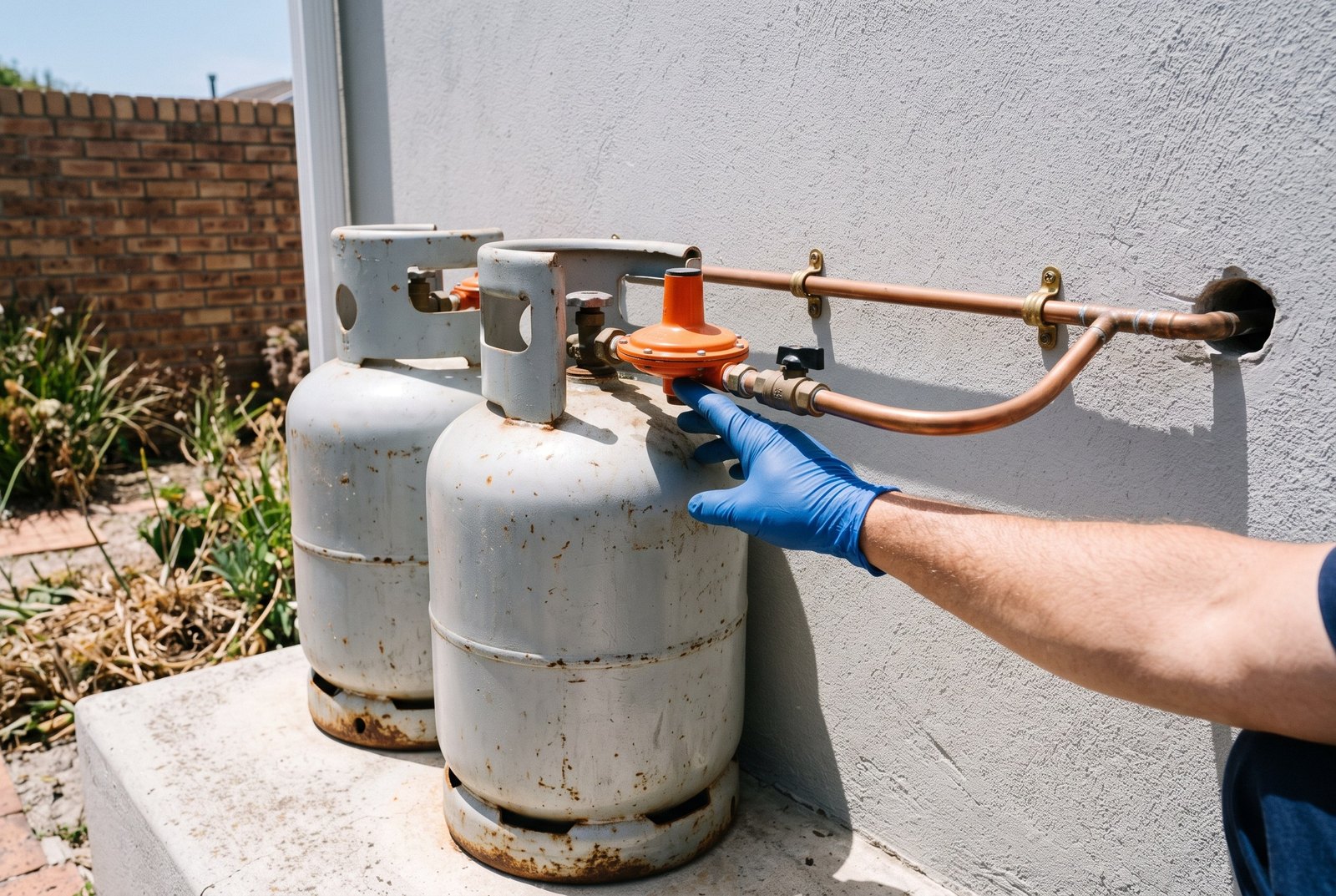
- Correct cylinder size and type, with indoor cylinders limited to 9 kg in a flat and 19 kg in a house (City of Cape Town)
- Cylinder location: firm non-combustible base, minimum clearances from doors, windows, drains, heat sources
- Not installed in enclosed garage, basement, or under staircase
- Correct regulator type and pressure setting (2.75 kPa for domestic)
- Regulator condition and service life
- Correct pipe material (copper or SANS-approved flexible)
- Pipe sizing per total gas load calculation (BTU/hr)
- Proper pipe support and saddling at correct intervals
- No mechanical damage or corrosion on any section
- Pressure leak test at 1.5× working pressure via calibrated manometer
- Pipes correctly routed — not through electrical conduit or confined cavities
- Correct flexible hose type — SANS 1156 compliant or equivalent
- Hose condition: no kinks, cracks, perishing, or abrasion
- Hose length ≤2 m, with no hose passing through a wall, partition, ceiling or floor (SANS 10087-1; City of Cape Town)
- Correct appliance type rated for indoor use (where applicable)
- Isolation valve fitted near each appliance — readily accessible
- Floor-level ventilation: 6mm gap under door or approved air bricks per SANS 10087-1
- Upper ventilation opening for gas water heaters (flue-less types)
- Flue routing for balanced flue water heaters — correct external discharge
- No gas pipework in same conduit as electrical cables
- Minimum clearance from electrical switches and sockets
Gas CoC Validity — A New Certificate of Conformity on Every Change of Ownership
A Gas Certificate of Compliance has no fixed expiry date. According to the SAQCC Gas Brochure 2026, published by the body that registers gas practitioners, the certificate is valid “for as long as no work has been done on the existing gas system since the original CoC was issued”.
A sale is the exception. Regulation 17(3) of the Pressure Equipment Regulations, 2009 lists a change of ownership among the events that require a certificate of conformity, and the Department of Labour’s 2017 Guidance Notes place that duty on the seller. The seller therefore books a new Gas CoC for the transfer, whatever the age of the existing one.
The “5 years” figure quoted online is a maintenance interval, not an expiry date. The 2008 edition of SANS 10087-1 asks the user to have appliances and pipework inspected “at regular intervals (not exceeding five years)”. No regulation sets a maximum age for the certificate at transfer. A date window, where one applies, comes from the sale agreement or the conveyancer, so check your offer to purchase.
- Selling the property = ❌ New Gas CoC needed for the transfer (Regulation 17(3))
- No gas work since the CoC was issued, and no sale = ✅ Certificate still valid (SAQCC Gas)
- New permanent gas appliance or pipework added = ❌ New CoC needed for that work
- Paper CoC issued from 1 April 2023 = ❌ Not valid, SAQCC Gas accepts electronic CoCs only
Our 5-Step Gas CoC Process
Gas CoC Cost in Cape Town (2026)
A gas Certificate of Compliance in Cape Town costs from R500 for a single-appliance installation, and a typical full call-out with inspection runs R750–R950 depending on installation size — with remediation charged only if faults are found. Bundle several certificates of compliance in one visit to save up to 22%. See the full price breakdown below.
| Installation Type | Inspection + CoC (Pass) | Typical Remediation |
|---|---|---|
| Single appliance (hob or fireplace only) | R500 – R750 | Hose replacement: R300–R600 |
| 2–3 appliances (hob + fireplace + heater) | R700 – R1,000 | Regulator + hose: R500–R900 |
| Full installation (hob, oven, water heater, braai) | R900 – R1,200 | Ventilation mods: R800–R2,500 |
| Commercial / rental property | R1,000 – R2,500+ | Quoted on scope |
6 Most Common Gas CoC Failures in Cape Town
- Insufficient floor-level ventilation — the most common failure. LPG is heavier than air and accumulates at floor level. SANS 10087-1 requires a minimum floor-level air opening (6mm gap under door or approved air brick) in any room containing gas appliances. Many kitchen renovations that added gas hobs did not install ventilation.
- Perished or kinked flexible hose connections — rubber hoses degrade over time (typically showing cracks, stiffness, or surface checking after 5+ years). Electronic gas detector testing often reveals micro-leaks at hose connections that soapy water testing misses.
- Incorrect cylinder placement — cylinders must not be in enclosed garages, basements, under staircases, or in low-lying areas where LPG can accumulate. Must be on firm, non-combustible bases with specific clearances from all ignition sources.
- Missing isolation valve near appliances — each appliance must have a readily accessible isolation valve. Installations where the only isolation is the cylinder valve (potentially in a locked cage) do not comply.
- Pressure leak failure — any measurable pressure drop during the manometer test indicates a leak in the system. Even very small leaks fail the pressure test.
- Outdated or over-rated regulator — regulators must be correctly rated for the total gas load of all connected appliances. Over-sized regulators on small installations, and regulators past their service life, are common non-compliance points.
Frequently Asked Questions — Gas CoC Cape Town
Does a gas hob or fireplace require a Gas CoC?
Yes — if permanently connected to fixed LPG pipework. A built-in gas hob, gas oven, fixed gas fireplace, gas water heater, permanently plumbed outdoor gas braai, or gas patio heater connected to fixed pipework all require a Gas CoC. A free-standing portable gas braai or heater connected to a small portable cylinder by a non-fixed hose does not.
My Gas CoC is 2 years old — do I need a new one to sell?
Yes. Regulation 17(3) of the Pressure Equipment Regulations, 2009 requires a certificate of conformity on a change of ownership, so the seller books a new Gas CoC for the transfer whatever the age of the existing one. Outside a sale, the certificate stays valid for as long as no work is done on the gas system, according to SAQCC Gas. Contact us as soon as you have a transfer date so we can schedule your inspection with the correct timing.
Can any gas technician issue a Gas CoC?
No — only a SAQCC Gas-registered installer may legally issue a Gas CoC. Always verify your inspector’s SAQCC registration number before booking — you can verify registrations on the SAQCC Gas website (www.saqccgas.co.za). Certificates from unregistered individuals are legally invalid.
Is LPG gas safe to use indoors in Cape Town?
Yes — when correctly installed and certified per SANS 10087-1, LPG is safe for indoor use. The key safety requirement is adequate floor-level ventilation — LPG is heavier than air and will accumulate at floor level in a poorly ventilated space, creating an explosion risk. A compliant installation with proper ventilation, correctly rated appliances, and a valid Gas CoC is safe. Never use commercial-grade appliances (designed for outdoor use) indoors.
Does my gas installation need to be registered with any authority?
No, not for a normal home. The Gas CoC is the compliance document for a residential LPG installation, and it goes to the conveyancer for the property transfer. Since 1 April 2023, SAQCC Gas accepts only electronic CoCs. Larger installations are the exception: storing or using more than 100 kg of flammable gas needs a flammable substance certificate from the City of Cape Town, under section 37(6) of its Community Fire Safety By-law.
What happens if I add a new gas appliance after the Gas CoC is issued?
Adding any new permanent gas appliance — a second hob, a gas fireplace, a gas water heater — invalidates the existing Gas CoC immediately. A new inspection covering the full updated installation is required before you sell. We recommend completing all desired gas installation changes before obtaining the Gas CoC if you plan to sell within the next 1–2 years — it minimises the number of inspections required.
Is a gas installation certificate the same as a gas Certificate of Compliance?
Yes. A gas installation certificate, a gas Certificate of Conformity and a gas Certificate of Compliance (CoC) all describe the same SANS 10087-1 document issued by a SAQCC Gas-registered inspector, confirming your LPG installation is safe and compliant. You need it whenever you sell a property that has a fixed gas installation.
What is an SAQCC Gas certificate, and is it the same as a gas CoC?
These are two different documents, and conflating them causes real delays at transfer. An SAQCC Gas certificate belongs to the installer — it is their registration credential, showing they are qualified and registered to work on gas installations. A Gas Certificate of Compliance belongs to the property — it certifies that your specific installation meets SANS 10087-1. A conveyancer needs the property’s Gas CoC for transfer. The installer’s SAQCC registration number appears on that CoC as proof of who was entitled to sign it, which is why the two get mixed up.
Do you need a CoC for a 9 kg gas stove?
It depends on how the stove is connected, not on the size of the cylinder. A 9 kg cylinder feeding a stove or hob that is permanently connected to fixed pipework is a fixed gas installation and requires a Gas CoC. The same 9 kg cylinder feeding a portable braai or heater through a non-fixed hose does not. The test is permanence of the connection. A common Cape Town case is a kitchen hob fed by a 9 kg cylinder in an under-counter cupboard — that is a fixed installation, and it needs certifying before transfer.
Gas CoC — Areas We Serve Across Cape Town & the Western Cape
Our SAQCC Gas-registered installers issue gas Certificates of Compliance across the Cape Town metro and the wider Western Cape — same-week appointments, with your certificate emailed within 24 hours of a pass. Find your area for a local gas CoC inspection.
Book Your Gas CoC Inspection — Cape Town
SAQCC Gas registered · SANS 10087-1 compliant · Registered, standards-based inspections · Fast turnaround for transfer deadlines