
Electrical Certificate of Compliance in Cape Town — Your DoEL-Registered CoC Electrician
Your electrical certificate of compliance in Cape Town is issued the same day it passes: a DoEL-registered electrician tests your installation against SANS 10142-1, inspections start at R850 across the full metro, and a certificate under 2 years old can be used for a property transfer.
Get a Free Electrical CoC Quote — Fast
Tell us what you need and we’ll send your price now.
Prefer to talk? Call 071 293 2423
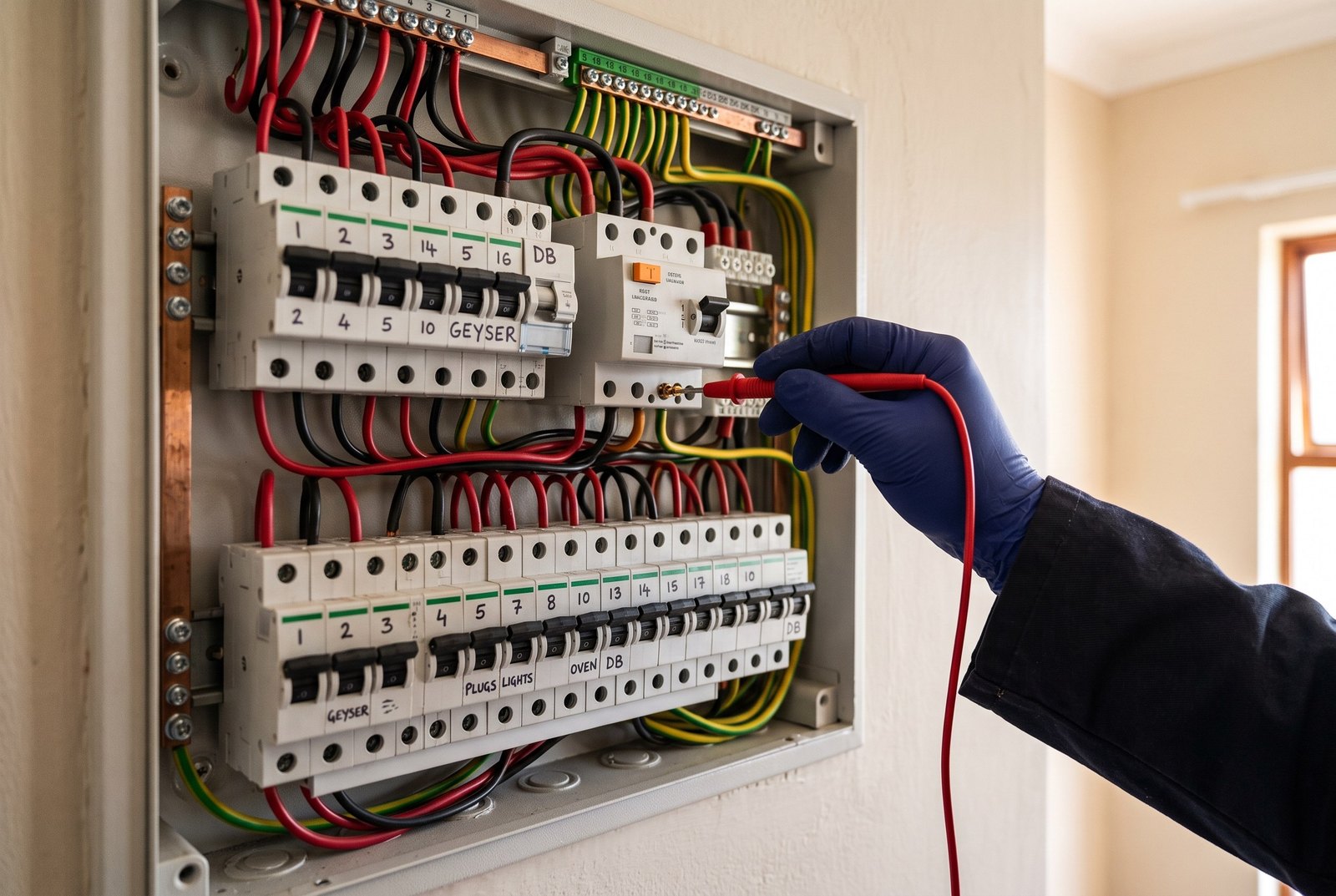
In short: an electrical CoC in Cape Town is a Certificate of Compliance confirming your electrical installation meets SANS 10142-1. It must be issued by a Department of Employment and Labour-registered electrician, and is legally required before any property in Cape Town can transfer to a new owner.
Getting Your Electrical CoC in Cape Town
We issue electrical Certificates of Compliance across the whole Cape Town metro — the City Bowl, Atlantic Seaboard, Northern Suburbs, Southern Suburbs, South Peninsula and the Helderberg. Whether you are selling, transferring or insuring a property, our DoEL-registered electricians inspect your installation against SANS 10142-1 and email your electrical CoC within 24 hours of it passing. Call 071 293 2423 for a same-day quote on your electrical CoC in Cape Town.
✔ Registered, Compliant & Accepted
Every electrical CoC we arrange is issued and signed off by a Department of Employment and Labour (DoEL)-registered electrician in line with SANS 10142-1 and the Electrical Installation Regulations. The issuing professional’s registration number appears on your certificate, so it is fully verifiable and accepted by conveyancers, banks and the Deeds Office. We only work with correctly registered electricians — a certificate from an unregistered person is not valid.
A CoC electrician is the DoEL-registered electrical contractor licensed to test your installation against SANS 10142-1 and issue the CoC electrical certificate a property transfer needs. Inspection and certificate run R850 to R1,800 across the Cape Town metro, averaging about R1,150, and regulation 7(5) accepts the certificate for a transfer until it is two years old.
COC Certificate delivers Electrical Certificate of Compliance inspections across Cape Town, Western Cape. COC Certificate has assisted property owners, sellers, buyers, estate agents, and conveyancers in obtaining their Electrical CoC on time and on budget. Every inspection is carried out by an electrician registered with the Department of Employment and Labour (DoEL) under the Electrical Installation Regulations, 2009.
- DoEL-registered electricians — regulation 11(4) entitles you to see each inspector’s certificate of registration
- Registered electrical compliance inspections for Cape Town property transfers —
- Certificates issued within the validity window — we understand Deeds Office transfer deadlines
- Full SANS 10142-1 test sequence using calibrated Megger MFT1735 multifunction testers
- Earth loop impedance testing, insulation resistance testing (up to 1,000V DC), RCD trip-time verification per circuit
- Thermal imaging inspection of DB boards included on larger properties — identifies hotspots invisible to the naked eye
- We supply and fit minor items on-site: DB labels, MCBs, cable clips, junction box covers — no extra call-out fee
- Itemised remediation quote within 2 hours of inspection — fixed-price, no hidden charges
- R5 million public liability insurance on every inspection
- Same-day certificate issuance on pass — emailed in DoEL-compliant format to seller, agent, and conveyancer
What Is an Electrical Certificate of Compliance?
An Electrical Certificate of Compliance — also called an electrical compliance certificate, electrical CoC or ECOC — is a legal document confirming that all fixed electrical installations on a property comply with SANS 10142-1: Wiring of Premises. It may only be issued by an electrician holding a valid Registered Person (RP) licence from the Department of Employment and Labour — either an Electrical Tester (ET), Installation Electrician (IE), or Master Installation Electrician (MIE). A pass depends on a standard set of electrical CoC tests — earth continuity, insulation resistance, polarity and earth-leakage (RCD) operation.
Regulation 7(1) of the Electrical Installation Regulations, 2009 (GN R.242, made under the Occupational Health and Safety Act 85 of 1993) requires every user or lessor to hold a valid certificate of compliance, “accompanied by a test report”. Regulation 7(5) sets the transfer rule: the owner “may not allow a change of ownership if the certificate of compliance is older than two years”. The CoC covers all fixed wiring from the point of supply (main DB board) through to every socket, switch, and light point — it does not cover appliances, light fittings, or the Eskom/City supply.
SANS 10142-1 carries the force of law: Government Notice R.243 of 2009 incorporates it into the Electrical Installation Regulations under section 44 of the OHS Act. The current edition is SANS 10142-1:2026 (Edition 3.03), approved by the SABS on 24 June 2026. An installation built before the current edition is tested against the “general safety principles” of the standard, according to regulation 9(2)(b), so an older home is not held to every clause written since it was wired.
Who Is a CoC Electrician? Department of Employment and Labour Registration
Only a registered electrical contractor may issue an Electrical Certificate of Compliance. Registration is held with the Department of Employment and Labour under the Electrical Installation Regulations of 2009, promulgated under the Occupational Health and Safety Act 85 of 1993. A certificate signed by anyone else has no legal standing, whatever it looks like.
A wireman’s licence is not contractor registration
These two documents are confused constantly, and the difference decides whether your certificate survives scrutiny. A wireman’s licence certifies an individual’s competence to carry out electrical work. Registration as an electrical contractor is a separate status held with the Department of Employment and Labour, and it is the one that carries the authority to issue a CoC.
Registration is renewed periodically and can lapse. A certificate signed on a date when the contractor’s registration had lapsed is invalid, even though the electrician remained perfectly competent. The registration number printed on your certificate is what a conveyancer, an insurer or a buyer’s attorney will check, so confirm it is current before the inspection rather than after.
Our inspectors carry current Department of Employment and Labour contractor registration, and the registration number appears on every certificate we issue. Ask for it before booking with anyone — a contractor who cannot produce a letter of registration on request is the single clearest warning sign in this trade.
What the Electrical Inspection Covers Under SANS 10142-1
- Earth leakage (RCCB) — ≤30mA trip threshold per SANS 10142-1
- Overcurrent protection (MCBs) — correct ratings per circuit
- All circuits correctly labelled
- Earthing and bonding connections verified
- No exposed live conductors or open knockouts
- Insulation resistance ≥1MΩ per circuit (tested at 500V DC)
- Correct conductor cross-section per circuit load
- Cable protection: conduit, trunking, or correctly clipped
- Correct polarity verified at every outlet
- Separation from water pipework (minimum 150mm)
- SANS 164-2 compliant socket types throughout
- Earth connection verified at all socket outlets
- No cracked or damaged faceplates
- Correctly fixed — no movement or loose mounting
- Bathroom circuits: zone compliance per SANS 10142-1
- Earth loop impedance tested per circuit (Megger MFT1735)
- Main earthing conductor sizing verified (min. 10mm² for TN-S)
- Earth electrode resistance measured
- Equipotential bonding of water and gas pipes
- Bonding of structural metalwork where applicable
Our 6-Step Electrical CoC Process
Electrical CoC Cost in Cape Town (2026)
An electrical Certificate of Compliance in Cape Town costs from R850, depending on property size and certificate scope — with remediation charged only if faults are found. Bundle several certificates of compliance in one visit to save up to 22%. See the full price breakdown below.
| Property Type | Inspection + CoC (Pass) | Typical Remediation Cost |
|---|---|---|
| Apartment / Flat (1–2 bed) | R850 – R1,400 | R0 – R2,500 (minor faults) |
| House (3 bed, single storey) | R1,200 – R2,000 | R0 – R5,000 (earth leakage, DB) |
| Double storey / large house | R1,800 – R3,500 | R0 – R12,000+ (wiring sections) |
| Commercial / sectional title | R2,500 – R8,000+ | Quoted on scope |
Remediation costs are quoted separately after inspection and are fixed-price before work begins. Prices above are for inspection plus certificate when the installation passes on the first inspection.
7 Most Common Electrical CoC Failures in Cape Town
- No earth leakage protection (RCCB) — the most common failure in pre-1990 properties. An RCCB (30mA trip) is mandatory per SANS 10142-1 on all circuits supplying sockets, bathrooms, and kitchens.
- Degraded wiring insulation — rubber or fabric-insulated cable loses elasticity over time. Insulation resistance below 1MΩ at 500V DC constitutes a SANS non-compliance requiring rewiring of affected circuits.
- Unlabelled DB board circuits — every circuit breaker must be clearly and correctly identified. Unlabelled boards fail immediately.
- Unpermitted DIY electrical work — additional sockets, light fittings, or pool pump circuits installed without a CoC update by previous owners.
- Incorrect or inadequate earthing — missing, undersized (minimum 10mm² for TN-S systems), or corroded main earth connections.
- Solar/inverter installation without CoC update — any DB-connected inverter installed after the last CoC needs a CoC for that work under regulation 7(4), and the City of Cape Town requires the transfer CoC to state whether a solar system is connected or disconnected. See our Solar CoC page.
- Exposed or unprotected conductors — cables not run in conduit, trunking, or properly clipped, particularly in ceiling voids, garages, and outbuildings.
Frequently Asked Questions — Electrical CoC Cape Town
Is an Electrical CoC legally required to sell my property in South Africa?
Yes. Regulation 7(5) of the Electrical Installation Regulations, 2009 (GN R.242), made under the OHS Act 85 of 1993, bars a change of ownership when the certificate of compliance is older than two years. The Department of Employment and Labour’s notice of 21 October 2025 states that a valid CoC “must be obtained and provided prior to the sale or transfer of any property”. The one exemption, in regulation 7(3), covers an installation that existed before 23 October 1992 with no change of ownership since 1 March 1994.
How long is an Electrical CoC valid for?
An Electrical CoC has no expiry date while the owner it was issued to keeps the property. The two-year limit applies at sale: regulation 7(5) bars a change of ownership when the certificate is older than 2 years. A property sold 18 months after the CoC was issued, with no electrical work done since, can use the existing certificate. Any addition or alteration (a new socket, a DB replacement, an inverter) needs a CoC for at least that work, under regulation 7(4). Henk Delport’s 2012 analysis of the regulations in the law journal Obiter reads them the same way: a valid CoC “remains valid indefinitely” in the hands of the owner it was issued to.
Who pays for the Electrical CoC — the buyer or the seller?
By South African legal convention, the seller is responsible for obtaining and paying for all compliance certificates. This is standard in the Agreement of Sale used by most estate agents. The parties may agree otherwise — always review the specific clauses of your sale agreement. Remediation costs are typically the seller’s responsibility as well. The Department of Employment and Labour’s notice of 21 October 2025 goes further: where an installation is later found to be non-compliant, “the seller will be held accountable for rectifying the defects and obtaining a new CoC at their own expense”.
What happens if my property fails the electrical inspection?
You receive a detailed fault report within 2 hours with every non-compliance itemised and a fixed-price remediation quote. Once repairs are completed, we re-inspect within 48 hours. Straightforward faults (RCCB fitting, DB labelling, cable protection) are often resolved within 1–2 business days. Certificate issued same day as the re-inspection pass.
Does my solar panel or inverter need to be on the Electrical CoC?
Yes — any solar PV system, battery backup, or inverter hardwired to the DB board must appear on the Electrical CoC. A system installed after the most recent CoC needs a new inspection and updated certificate before transfer. See our Solar CoC page for a full breakdown including SSEG grid registration. The City of Cape Town’s SSEG requirements (section 1.12) state that the CoC issued for a transfer “must include a statement regarding the state of connection or disconnection” of the system. The City orders an unregistered system to be disconnected within five working days, with a CoC as proof.
My property was built in 1975 — will it definitely fail?
Not necessarily. Many older Cape Town homes have been upgraded and already have RCCB protection and compliant wiring. The key factors are: (1) whether a modern DB board with earth leakage was installed, (2) whether wiring has been updated or is still original rubber-insulated cable, and (3) whether unauthorised electrical work was done. Regulation 9(2)(b) of the Electrical Installation Regulations tests an installation built before the current edition of SANS 10142-1 against the standard’s “general safety principles”, not every clause added since. We recommend booking an inspection 3–4 weeks before your planned listing date to allow time for any remediation.
How quickly can I get an Electrical CoC in Cape Town?
For properties that pass the first inspection, we issue the certificate the same day. Inspections are booked within 1–2 business days of your request; same-day available on request in most areas. For properties requiring remediation, the total process from booking to certificate typically takes 3–7 business days.
Can I use an Electrical CoC from a previous property transfer?
Yes, when the CoC is under 2 years old and no electrical work has been done since it was issued. Regulation 7(5) measures the certificate’s age at the change of ownership, so a CoC from a sale 18 months ago still qualifies. Work done since then needs a CoC for at least the addition or alteration, under regulation 7(4).
Does a pool pump or borehole pump need to be on the Electrical CoC?
Yes — if permanently wired via a fixed circuit to the DB board, it must be included in the inspection. Pumps connected via a standard plug into a socket are assessed as part of the socket circuit. The circuit feeding a permanently wired pool pump must have correct overcurrent protection, RCCB protection, and earth continuity verified.
What are the insurance implications of a non-compliant electrical installation?
Many South African short-term insurance policies let the insurer decline a claim when the electrical installation was non-compliant at the time of loss. The wording differs between insurers, so read your own policy. A valid CoC with its test report is your evidence that the installation complied.
Who registers electrical contractors in South Africa?
The Department of Employment and Labour. In a 2021 statement the Department confirmed that only it may issue a letter of registration to an electrical contractor, under regulation 6 of the Electrical Installation Regulations, 2009. The Electrical Conformance Board registered contractors on the chief inspector’s behalf until 31 May 2012, and the nine DoEL provincial offices have done it since 1 June 2012 (Guidance Notes, GN 258 of 2012). The Department’s October 2025 notice states that a registered contractor who issues a CoC on behalf of an unregistered individual commits a criminal offence. Regulation 15 sets the penalty for breaching the CoC rules: a fine or imprisonment of up to 12 months. Ask to see your inspector’s certificate of registration before booking, which regulation 11(4) obliges a registered person to produce on request.
Does a sectional title unit need its own Electrical CoC?
Yes — each individual sectional title unit requires its own Electrical CoC covering the electrical installation within that unit. The body corporate may hold separate CoC documentation for common areas. When purchasing a sectional title property, ensure the CoC provided covers the specific unit you are purchasing, not only the common property.
What tests are done for an electrical CoC?
An electrical CoC inspection runs the SANS 10142-1 test sequence: earth continuity, insulation resistance (must read at least 1 MΩ), polarity and correct connections, earth-leakage (RCD) trip testing, plus a check of the distribution board, bonding and earthing. Every test point must pass before the certificate is issued.
How do I check my electrician is registered with the Department of Employment and Labour?
Ask for the letter of registration before work starts and confirm it with the Department of Employment and Labour’s provincial office, which verifies letters of registration on request. No public online database of registered electrical contractors exists in South Africa, which is why forged letters circulate. Check that the registration number on the letter matches the number printed on the certificate you are handed, and that the registration was current on the date the certificate was signed.
How much do electricians charge for a CoC in Cape Town?
Electrical CoC inspections in Cape Town start from R850 for a flat or apartment, with a standard house typically around R1,150 and larger homes up to R1,800. The figure covers the inspection, the test report and the certificate. Repairs to bring a failed installation up to SANS 10142-1 are quoted separately once the inspection identifies them, because no honest electrician can price unseen faults in advance. Treat a quote materially below this band with caution — it usually signals a desk-issued certificate with no inspection behind it.
Book Your Electrical CoC Inspection — Cape Town
Registered, standards-based inspections · DoEL registered · Same-day certificate on pass · Full Cape Town metro coverage
Service Areas — Electrical CoC
We cover the entire Cape Town metropolitan area including Cape Town, Durbanville, Bellville, Brackenfell, Table View, Milnerton, Somerset West, Strand, Gordon’s Bay, Goodwood, Kuils River, and all surrounding suburbs within a 60km radius of the Cape Town CBD.